What Is Qi and How Do Meridians Work?
In Traditional Chinese Medicine, qi (pronounced "chee") is the word for the body's functional energy, the activity that keeps your blood moving, your digestion working, your temperature steady, and your mind clear. Meridians are the pathways along which that activity is described as flowing, connecting the surface of the body to the internal organs. Acupuncture works by placing fine needles at specific points along these pathways to influence how the body regulates itself. That is the honest version. Qi is not a mystical force you need to believe in for the treatment to help. It is a framework, developed over two thousand years of careful observation, that lets a practitioner read your body and decide where to treat.
At Piraluna in Lamai, Claire trained at Chengdu University of TCM, one of the oldest TCM institutions in China. We use this language every day because it is precise and useful, but we also know many of our patients come from a Western background. So let us explain what these ideas actually mean in practice.
A Grounded Way to Understand Qi
The simplest way to think about qi is as the sum of everything your body is doing to keep you functioning. When TCM says your qi is strong, it means your systems are working well and you have energy to spare. When it says your qi is weak or stuck, it is describing something you can usually feel for yourself.
- Qi deficiency looks like fatigue, low appetite, getting sick easily, or feeling worn down even after rest.
- Qi stagnation shows up as tension, irritability, a feeling of being stuck, or pain that moves around.
- Smooth, balanced qi is the state of feeling energetic, calm, and resilient.
You do not need to accept any claim beyond this: the body has patterns, those patterns are readable, and TCM has a vocabulary for them that guides treatment. Whether the right word is qi or "nervous system regulation" or "circulation," the practical work is the same.
What Meridians Actually Describe
Meridians are the map. There are twelve main meridians, each linked to an organ system, and they run in lines across the body, along the arms, the legs, the torso, and the head. Along these lines sit the acupuncture points, several hundred of them, each with a known effect.
It helps to think of meridians less as physical tubes and more as a functional map of relationships the body has shown over centuries of practice. A point on the wrist can affect the chest. A point below the knee is one of the most reliable points for digestion. These connections were mapped by observing what happened when points were stimulated, and modern practice still relies on that accumulated knowledge.
When the flow along a meridian is described as blocked or weak, symptoms appear along its path or in the organ it relates to. Treatment aims to restore movement and balance to that pathway.
How Acupuncture Engages the Meridians
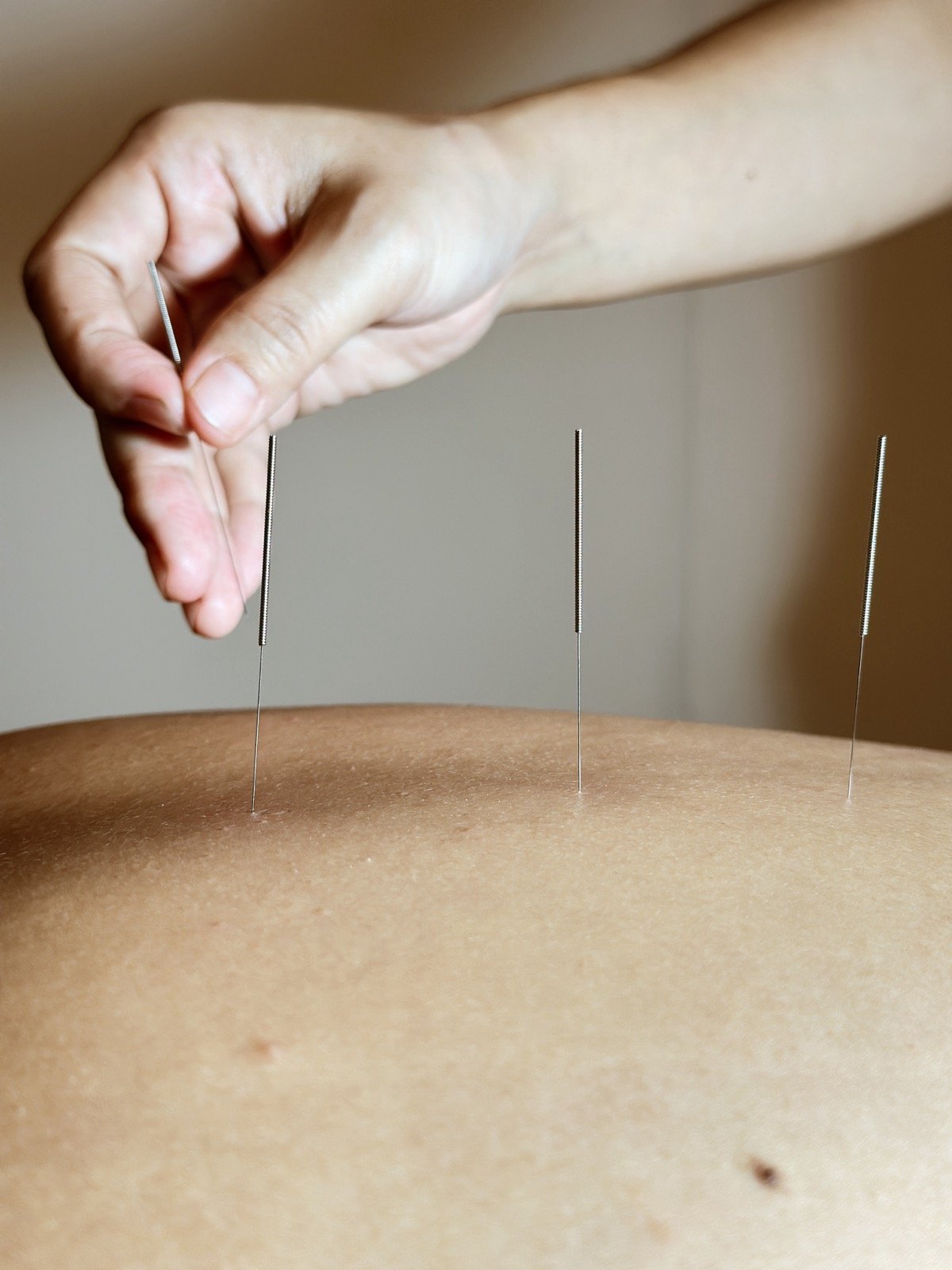
During a session, Claire chooses points based on your specific pattern, not from a fixed recipe. A fine needle, about the width of a human hair, is placed at each point and left in for twenty to forty minutes while you rest. Many points produce a mild, spreading sensation when activated, called de qi, which often travels along the meridian line. Patients describe it as a dull warmth or a gentle wave, and it is a sign the point is engaged.
From a physiological angle, stimulating these points has measurable effects. It can shift the nervous system out of fight or flight and into rest and repair, release the body's own pain relieving chemicals, improve local blood flow, and calm inflammation. The meridian framework and the modern explanation are not in conflict. They are two descriptions of the same useful thing. If you want a fuller walkthrough of the experience, read about what to expect at your first acupuncture session.
Why the Framework Matters for Your Treatment
This is not abstract. The qi and meridian framework is exactly what allows Claire to treat the root of a problem rather than only the symptom. Two patients with the same headache may have completely different underlying patterns, one from tension and stress, another from poor sleep and depletion. Reading the qi tells us which is which, and that changes which points we use.
It also means we treat the whole person. Your digestion, sleep, stress, and pain are connected in this model, so a single treatment often improves more than the thing you came in for. Many patients arrive for one complaint and notice they are sleeping better within a few sessions. You can read more about the ideas behind the medicine on our acupuncture page, or learn about Claire's training on our practitioners page.
Curious to Feel It for Yourself?
You do not have to believe in qi to benefit from acupuncture, just as you do not have to understand electricity to turn on a light. The framework guides the treatment, and the results speak for themselves. If you are curious about how this ancient system might help with pain, stress, sleep, or general well being, the best way to understand it is to experience it.
Book a session at Piraluna and let us show you, in plain and honest terms, how this medicine works with your body.